Charles S. Burwell, cardiologist and dean of Harvard Medical School, dropped a phrase that should be on the door of many clinics:
"Half of what we are going to teach you is wrong, and the other half is right. Our problem is that we don't know which half is which."
Today I am talking to you.
Whether you are a podiatrist, traumatologist, physio…
Keep this phrase in mind.
The problem isn't always your patient's foot, but the way you treat it. With that modern habit of putting a crutch on everything. As if the foot were a defective part.
If it hurts → insole.
If it sinks → insole.
If it twists → insole.
If the toe overlaps → surgery.
Because the foot is not a wobbly chair. The foot is alive.
It has muscles, joints, skin, sensitivity. And it has a capacity for adaptation and memory.
The memory of years stuffed into rigid, narrow shoes, with heels, funnel-shaped toe boxes, and soles that do the work its body should be doing.
The real problem: never questioning what is accepted as truth
Because the problem is not that a professional makes a mistake. The problem is never reviewing what is taken for granted as true.
And now there are alternatives. The first is always to switch to foot-shaped footwear and do corrective exercises. A much more interesting option before touching the foot with a scalpel or putting it on lifelong crutches.
And if an insole is needed, it should be inside a shoe that doesn't continue deforming the foot or their posture.
Three stories that change the perspective
A woman had canceled three operations with three different surgeons. She had poor mobility in her second toe. They talked to her about more surgery. Until someone looked at her ankle, exercises, toe spacers, and footwear. The process was slow. But the pain that always accompanied her disappeared. Imagine that.
Another person with a bunion was told that, if operated, they would also have to shorten several toes because they were long. They didn't get surgery. Started with barefoot. Two years later, they had improved significantly.
A 40-year-old woman was born with her feet turned inwards. Orthopedic shoes as a child, then insoles. "Thank goodness I discovered barefoot shoes."
An insole shouldn't always be the first, the only, and the eternal answer.
Helping for a while is one thing. Turning their foot into an invalid for the rest of their life is another.
The shoes you wear matter. A lot.
And now I'm talking to you. Not as a professional. As a person who puts their feet in a shoe every morning.
Because the footwear you put on matters. A lot.
And that's why a sandal like the one I'm bringing you today makes so much sense.
Because in summer you can do two things:
The common choice
Stuff your foot into a rigid sandal, with a nice shape on the outside but narrow on the inside.
The smart alternative
Give it space, a good fit, and a sole that protects without losing the feel of the ground.
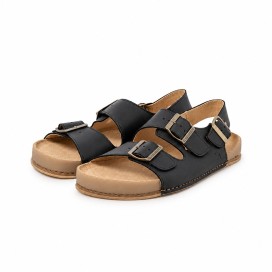
Berna: barefoot leather sandals for daily use
The Berna is made of bovine leather, features buckles for a great fit, a 16 mm rubber sole, is flat, and designed for everyday use, traveling, and walking for hours without your foot fighting against the sandal.
So your toes aren't squashed
So your foot works more naturally
So you can stop treating it like it needs crutches
Technical specifications
Type
Barefoot sandal
Material
Bovine leather
Fastening
Adjustable buckle
Sole
100% rubber, 16 mm, flat
Last
Comfort (toe space)
Colors
Black · Stone · Terra
Sizes
37 – 46 (Unisex)
Use
Urban, travel, daily casual
Frequently asked questions about barefoot sandals and natural footwear
In many cases, switching to footwear with an anatomical shape and flat sole is the first step that professionals overlook. It doesn't replace medical treatment, but it's a foundation that allows the foot to recover its natural function.
Yes. With its 16 mm rubber sole, it offers enough protection for beginners without the excess cushioning that disconnects the foot from the ground. It's a comfortable and progressive transition.
Daily, urban, and travel use. It works great for walking for hours, sightseeing, and environments where you need stability and comfort without sacrificing aesthetics. It is not designed for trail or hard terrains.
If necessary, they should be inside footwear that doesn't continue to deform the foot. The important thing is not to combine two problems: corrective insoles + shoes that squash toes or force your step.


















































 Español
 Português PT
 Deutsch