


Boots or trainers for the Camino de Santiago? You’re asking the wrong question.
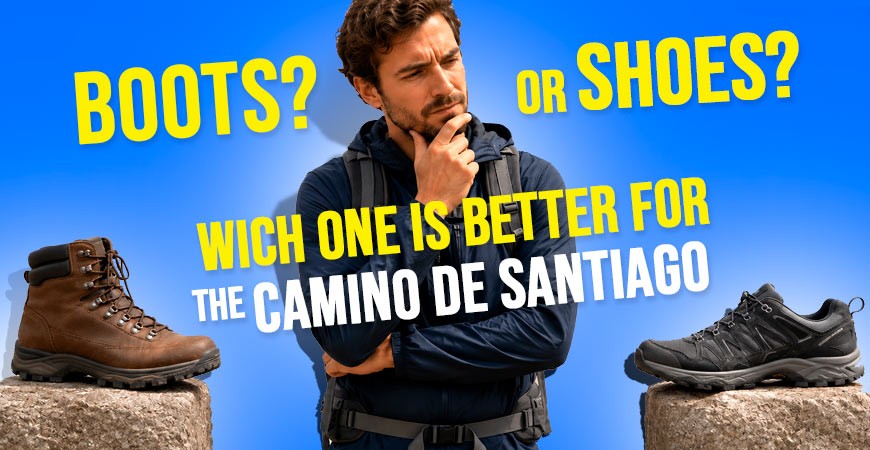
I'm going to tell you what footwear to choose for the Camino de Santiago, taking into account something more important than the brand, the price, or having “trekking” written on the box: the terrain you will step on. Walking 25 kilometers on compact dirt tracks is not the same as doing so over stones, mud, and technical descents.
The myth of boots on the Camino
Every year, when this season approaches, we receive the same question: —Antonio, which boots should I buy for the Camino? And many times I would start with another question: Why boots?
In 2006 I walked the last 100 kilometers from Sarria with Rubén. I wore sneakers; Rubén, boots. On the first day, he ended up going into a shop to buy hiking sneakers because his feet couldn't take it anymore. The boots ended up in the trash.
But that doesn't mean a boot is bad. It means more protection is not always better.
For most of the Camino, I would choose sneakers
If you walk on forest tracks, compact dirt paths, asphalt, and simple trails, a barefoot trail sneaker usually has everything you need: less weight, less material around the foot, more breathability, and more freedom for the ankle. And after 20, 25, or 30 kilometers, moving less weight thousands and thousands of times is much appreciated.
Listen: you're not climbing K2. You are going to walk, most of the time over non-technical terrain. A barefoot trail sneaker with a lugged sole is enough to give you grip without turning each foot into a brick.
What if there are lots of stones?
Here the movie changes. The more broken, stony, and uneven the terrain, the more important sole thickness and design become. Not because you should stop feeling the ground, but because doing 200 meters over rocks is not the same as doing 8 kilometers.
A very thin sole that is wonderful on compact dirt can end up fatiguing you when every footstep has a rock waiting underneath. The terrain rules. In these rocky or highly uneven areas, a barefoot sneaker with more protection and good lugs is better.
When would I choose a boot?
With abundant mud, rain, cold, complicated terrain, or when you simply feel safer wearing it. Mid-height solutions also exist: footwear that covers more of the foot and ankle, but maintains the light feeling and mobility of sneakers.
This is not about saying: sneaker good, boot bad. Every Camino is different, and every person is too.
And there's something even more important
Don't wear brand new footwear on day one! For goodness' sake. Test it beforehand: put in kilometers, step on dirt, rocks, go uphill, downhill, and do a long outing with the backpack you will carry. Because you can buy the best footwear in the world and turn it into the worst if your feet aren't prepared to use it.
What footwear to choose for the Camino de Santiago?
To make it easier, here are some tables. Don't look at them thinking which is best: look at them thinking what terrain you will step on for the most hours.
Sneakers: my first choice for most
If you do the Camino in spring or summer and most are tracks, dirt paths, and uncomplicated trails, I would choose sneakers: less weight, more ventilation, and if they get wet one day, they will usually dry faster.
Mid-cut: the middle ground
This category is for those who want something more protected than a sneaker, but don't want to carry a traditional boot. There you have the Vivobarefoot Magna, Xero, and Groundies mid-cuts: they cover more of the foot, keep dirt out, and offer more protection, while maintaining much more mobility than a traditional boot. For certain Caminos, they can be the sweet spot.
Boots: when terrain and weather get rough
Do you see now why asking me simply whether boots or sneakers are better for the Camino is of little use? If you're going to do 25 kilometers in hot weather on a compact dirt track, I wouldn't carry a boot: more weight, more heat, less breathability. But if you're going to encounter mud, rocks, steep gradients, and complicated terrain... the movie changes.
And watch out for another thing: more thickness doesn't automatically mean better either. The thinner the sole, the more information your foot receives from the ground. The rockier the path and the less adapted you are, the more you might appreciate a few extra millimeters filtering out the rocks.
That balance between sensitivity and protection is much more important than looking for “the best sneaker for the Camino de Santiago.” Because it doesn't exist: there is the best one for YOUR Camino. That's just how it is.
Indeed.
Health starts in your feet.
— Antonio Caballo











































 Español
 Português PT
 Deutsch