Which Xero Shoes hiking shoes to choose without wasting your money
Posted on2 Months agoby@antonio_caballo1513
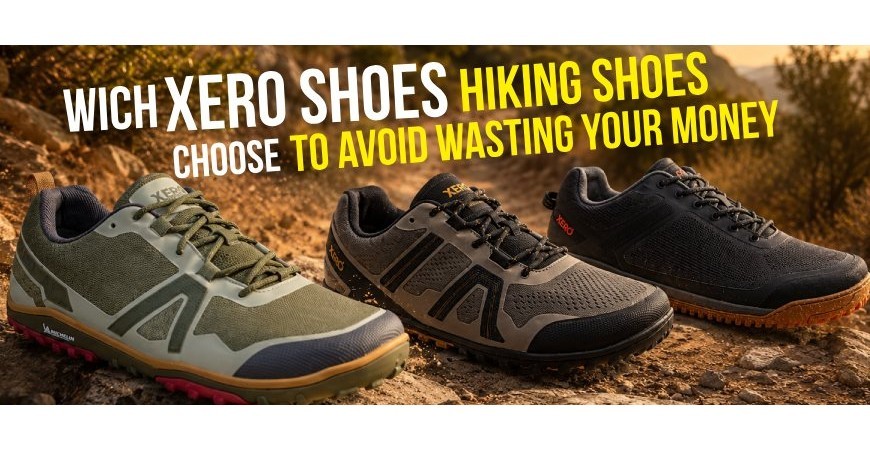
Three Xero Shoes trail models.
All three feature mesh uppers.
All three are breathable.
And none are waterproof.
I want to make that clear right from the start.
You won't find a shoe here for wading through ankle-deep mud or hiking for three hours in the rain.
These are shoes for spring and summer.
For dry trails.
For hot days.
For those who prefer their feet to breathe rather than be trapped inside a plastic bag.
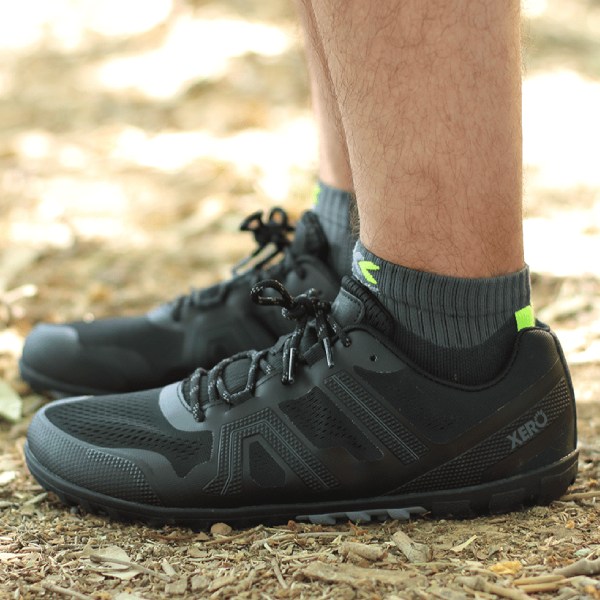
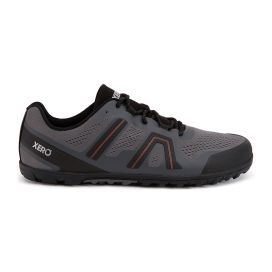
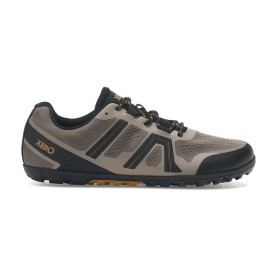
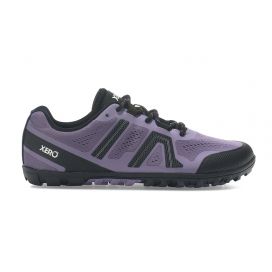
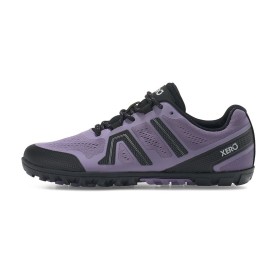
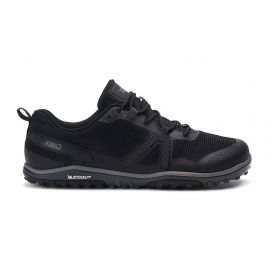
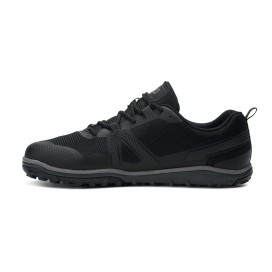
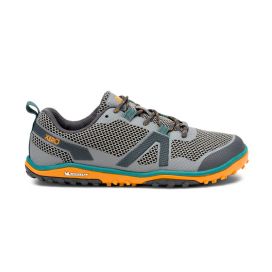
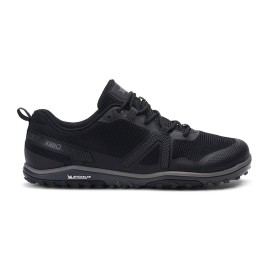
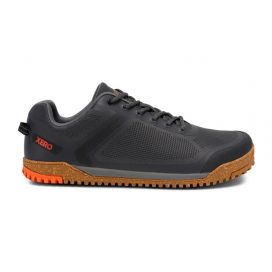
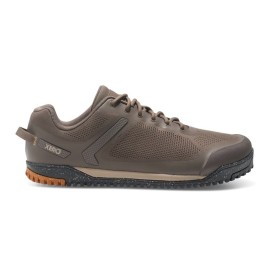
I’ve compared the Mesa Trail II, the Scrambler Low EV, and the Ridgeway Mesh Low.
I’ve flexed their soles.
I’ve tested how well they secure the foot and how much ground feel they offer.
And although all three share the same brand, zero-drop design, and breathable uppers, they aren't competing for the same terrain.
The Mesa Trail II prioritizes lightness and ground feel.
The Scrambler Low EV aims to protect you and provide grip when the terrain gets tricky.
The Ridgeway Mesh Low is designed to handle a hike, a trip, and an afternoon walking around the city.
All three are barefoot-style shoes.
All three are suitable for the trails.
But choosing the wrong one could leave you with too much shoe.
Or with less protection than your feet can handle.
Let’s see which one makes sense for you.
Quick comparison table
Specification
Xero Shoes Mesa Trail II
Xero Shoes Scrambler Low EV
Xero Shoes Ridgeway Mesh Low
What does this mean for you?
Main focus
Light trail running and dry paths
Technical trail, strong grip, and more demanding mountain
Hiking, travel, and urban use
Don't buy by “mountain”. Buy by the type of mountain you do.
Drop
0 mm
0 mm
0 mm
The heel is not elevated. Your posture is not distorted by a wedge.
Thickness without insole according to ZaMi
8.5 mm
12 mm
11.5 mm
The Mesa is the most direct. Scrambler and Ridgeway protect you more.
Weight
222 g
261 g
299 g
The Mesa feels faster. The Ridgeway is intermediate. Scrambler prioritizes traction.
Sole / lugs
FeelTrue™ with 3.5 mm lugs and TrailFoam™
Michelin Fiberlite with integrated TrailFoam™
Aggressive sole with TrailFoam™ and protected toe cap
Mesa reads more ground. Scrambler grips more. Ridgeway mixes protection and aesthetics.
Rain resistance
No
No
No
If you want waterproof, look at WP versions. These three are not for serious rain.
Best use
Running, dry trails, fast routes
Walking on technical trail, rock, demanding mountain
Hiking, travel, daily use
Here is the real decision. Choose according to what you are going to do with them.
1. Xero Shoes Mesa Trail II: the lightest and “purest”
The Mesa Trail II is the shoe for you if you want your foot to function naturally while moving through the mountains.
What does that mean?
It means you stay close to the ground.
The sole flexes. Your foot does the work.
And when you step on a root, a rock, or a patch of uneven terrain, your brain gets the signal before it’s too late.
That’s the barefoot experience.
The Mesa Trail II makes sense if you run on dry trails, dirt paths, packed tracks, or fast routes where you want to stay agile.
The Mesa won’t lie to you there.
It tells you the truth.
Rock by rock.
2. Xero Shoes Scrambler Low EV: the most technical and with best traction
The Scrambler Low EV is the model that distances you the most from the barefoot feel.
And I don't mean that as an insult.
I say it because there are days in the mountains when feeling every little pebble doesn't make you feel freer.
It just slows you down.
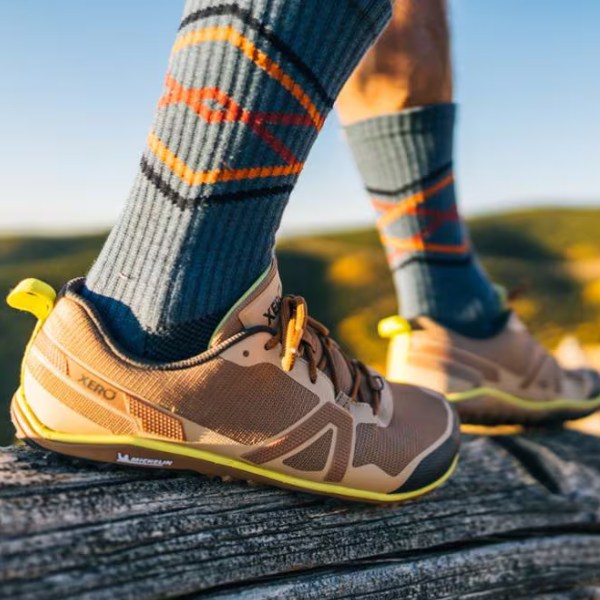
The big difference with the Scrambler lies in its Michelin sole, which features an integrated layer of TrailFoam.
You choose this shoe when you want more grip. More confidence. That "I can head down this way without saying a prayer" feeling.
The Scrambler Low EV is for you if you tackle more technical mountain terrain—rocky ground, steep ascents and descents, and trails where a thin sole would leave you vulnerable.
3. Xero Shoes Ridgeway Mesh Low: the most versatile and urban
The Ridgeway Mesh Low plays by different rules.
You can go for a hike, walk all day, travel, or stop for a drink without feeling the need to take off your hiking shoes.
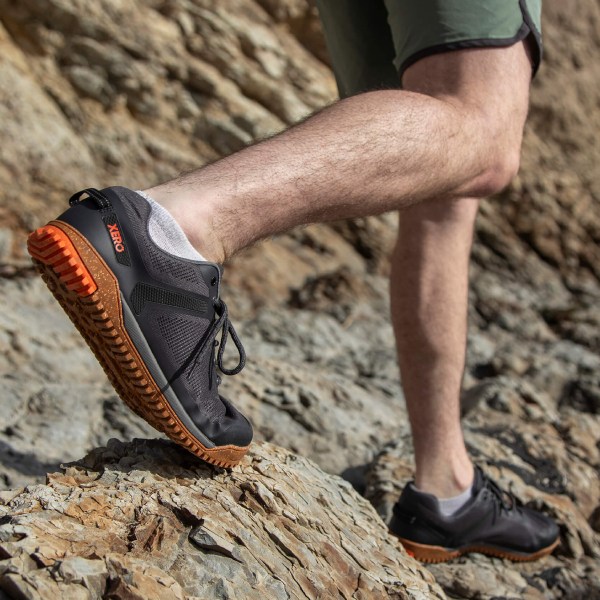
An interesting detail is the visual effect of the sole.
Xero calls it the "Midsole Illusion."
It looks like it has a thick midsole.
But it doesn't.
Because some people want a barefoot feel but don't want to look like they're wearing a minimalist shoe.
The Ridgeway Mesh Low is made for travel.
For leisurely hiking.
For the Camino de Santiago.
For switching between the trail and the city.
It isn't the fastest of the three.
Nor does it offer the most grip.
But it is the most versatile if you want a shoe for almost everything.
Field analysis
Espaço de verdade para os dedos dos pés, incluindo o dedão.
All three maintain the central idea of Xero: wide toe box, zero drop, and flexible sole. This means that your toes are not punished against a narrow wall; the big toe participates.
The difference is in how each one holds: the Mesa Trail II feels lighter and more enveloping (more of a running shoe); the Scrambler Low EV holds more as a whole, and the Ridgeway Mesh Low feels more like a walking shoe, more comfortable for daily use.
Ground feel vs. protection
There is no mystery here:
Mesa Trail II: more ground feel, more info, more demand.
Scrambler Low EV: more protection and traction. Less fine reading of the ground. More confidence in complex terrains.
Ridgeway Mesh Low: more balanced for walking. Doesn't seek to be the fastest, but the most wearable.
The upper
The Mesa Trail II has the lightest upper. It feels almost like a technical sock: light, flexible, and very close to the foot, with lateral and toe cap protection elements for scuffs.
The Scrambler Low EV is more robust: its upper is thicker and more resistant, with reinforcements to protect the foot from impacts and friction, but without making it a closed and suffocating shoe (it still lets the foot breathe).
The Ridgeway Mesh Low goes one step further in protection: it has a more pronounced toe cap, the sole rises along the sides to better protect from the terrain and impacts, and the mesh upper is robust but breathable.
None of the three are waterproof. And none will turn an unadapted foot into a foot ready for long mountain walks. A shoe doesn't do that; time does. And your ego usually goes faster, so give your feet time.
Final verdict
If you want to run on trails and you are already adapted to barefoot, choose the Mesa Trail II: it's the one that makes the most sense if you want lightness, flexibility, and connection with the ground.
If you do more technical mountains, rocks, and descents where you need to trust the sole, choose the Scrambler Low EV.
And if you want a shoe for routes, travel, walking a lot, and also using in the city, choose the Ridgeway Mesh Low. It is the least radical.
Which one to choose according to your use?
Your case
Recommended model
You run on trails and want maximum lightness
Mesa Trail II
You are highly adapted to barefoot
Mesa Trail II
You want maximum ground feel
Mesa Trail II
You do technical mountains, rocks, and demanding descents
Scrambler Low EV
You prioritize traction
Scrambler Low EV
You want barefoot, but with more protection
Scrambler Low EV or Ridgeway Mesh Low
You walk a lot, travel, or do long routes
Ridgeway Mesh Low
You want a shoe for mountains and city
Ridgeway Mesh Low
You prioritize casual aesthetics
Ridgeway Mesh Low
FAQ
The Mesa Trail II. It is the lightest, thinnest, and most direct; the one that lets the foot work the most and transmits the ground the most.
The Scrambler Low EV. Its Michelin Fiberlite sole is the main argument. If your priority is traction on technical terrain, start there.
The Ridgeway Mesh Low if you want to walk many kilometers and also use it off the path.
The Scrambler Low EV if you go for more mountainous stages or prioritize grip.
The Mesa Trail II I would only choose if you already have adapted feet and want to go very light.
Not in these versions. If you want serious rain, constant mud, or routes with lots of humidity, look at WP versions. These three prioritize breathability, lightness, and movement.
You can, but I wouldn't recommend it as a first option for long routes. For mountains, better a technical sock or toe socks if you want to avoid friction between toes and better manage sweat.
In barefoot, you don't want your toes touching the front. You need a margin for the foot to expand, especially going down. If you go down a slope and your toes collide, you haven't bought freedom: you've bought black toenails.















































 Español
 Português PT
 Deutsch